How to Automate Business Workflows Using AI (Step-by-Step Guide)
Learn how to automate your business workflows using AI with this step-by-step guide. Reduce manual work, improve efficiency, and scale operations.
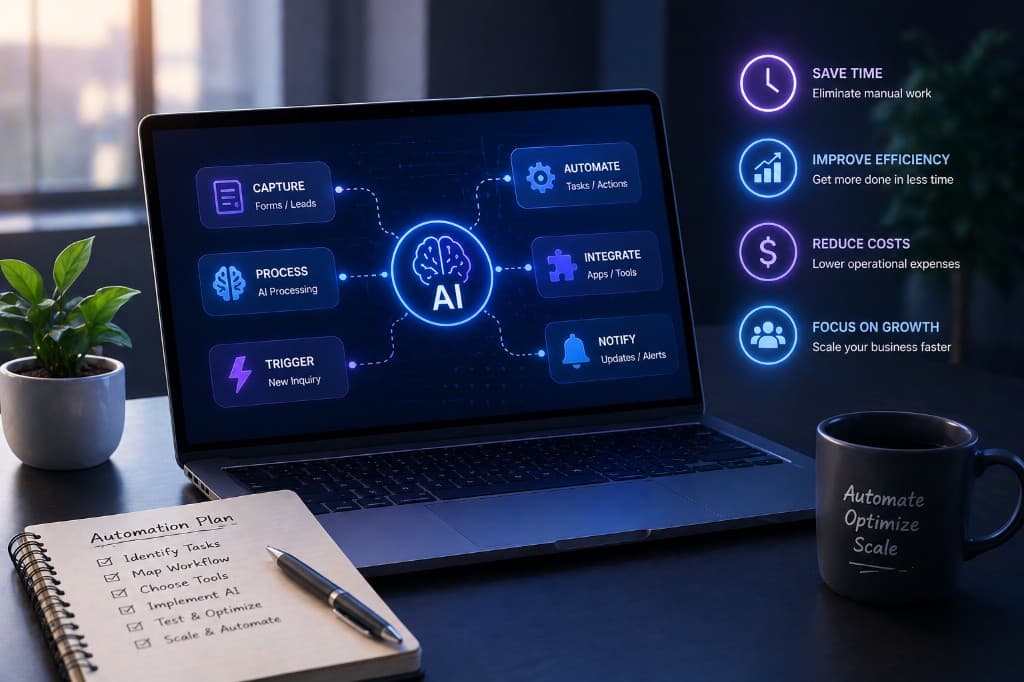
AI is no longer a future concept. It is a practical tool businesses are using today to reduce manual work, improve efficiency, and scale operations.
The challenge is not access to tools. The real challenge is knowing what to automate, how to structure it, and how to make it work reliably.
This guide breaks it down into a clear, step-by-step approach you can actually implement.
What is AI workflow automation?
AI workflow automation is the process of using intelligent systems to handle repetitive tasks, connect tools, and reduce manual effort across your business.
Instead of managing tasks manually, you build systems that run automatically.
- Tasks happen automatically
- Systems talk to each other
- AI adds intelligence to decisions
Step 1: Identify repetitive tasks
Start with your biggest time drains. Look for tasks that are repeated daily or weekly, rule-based, time-consuming, and prone to human error.
Common examples include lead data entry, follow-up emails, CRM updates, report generation, and internal notifications.
If a task is predictable, it can be automated.
Step 2: Map your workflow
Before using AI, understand your process clearly.
Example workflow: Lead Form to Email Notification to CRM Entry to Follow-up Email.
- Trigger: what starts it
- Actions: what happens next
- Outcome: final result
Clarity here prevents bad automation later.
Step 3: Choose the right tools
You do not need complex stacks. Focus on tools that integrate easily, are reliable, and scale with your business.
- Workflow automation tools
- AI tools for text, classification, and decision support
- Integrations that connect your systems
Simplicity beats complexity.
Step 4: Add AI where it actually helps
AI should enhance your workflows, not complicate them.
- Generating responses
- Classifying leads or requests
- Summarizing information
- Assisting decisions
Instead of sending a fixed email, use AI to generate a contextual reply based on user input.
Practical insight
At this stage, many businesses struggle, not because of tools, but because of how systems are structured.
At Naresh Kumar Consulting, the focus is on designing AI-driven workflows that actually work in real business environments, not just connecting tools.
Step 5: Connect your systems
This is where real efficiency happens. Connect website forms, CRM, email systems, and internal tools.
The goal is zero manual data transfer.
Step 6: Start small and test
Do not automate everything at once. Start with one workflow that saves time immediately.
- Accuracy
- Reliability
- Edge cases
Good automation is stable, not rushed.
Step 7: Measure impact
Track what actually improves:
- Time saved
- Reduction in manual work
- Response time
- Conversion rate
If it does not impact business metrics, it is not valuable.
Step 8: Scale gradually
Once one workflow works, expand to other processes, connect more systems, and add smarter AI logic.
Build connected systems, not isolated automations.
Real-world use cases
Lead management
- Capture leads automatically
- Qualify using AI
- Send personalized follow-ups
Customer support
- AI handles basic queries
- Escalates complex issues
Operations
- Automate reporting
- Sync data across systems
- Trigger internal alerts
Marketing
- Automate campaigns
- Generate content
- Manage workflows
Common mistakes to avoid
- Automating broken processes
- Using too many tools
- Overcomplicating workflows
- Skipping testing
- Focusing on tools instead of outcomes
What is the best way to start?
Start with one workflow that saves time immediately, then expand.
Final thoughts
AI automation is not about replacing people. It is about removing repetitive work so your business can operate faster and smarter.
Most businesses do not struggle because of lack of tools. They struggle because their systems are not designed properly. That is where structured, AI-driven workflows make a real difference.
Ready to automate your business workflows?
If you are looking to reduce manual work, automate operations, and build scalable systems, this is exactly what we do at Naresh Kumar Consulting.
Book a strategy call to identify the highest-impact automation opportunities in your business.